
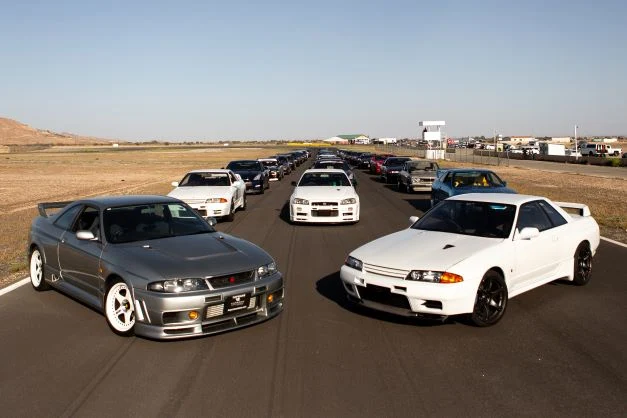
The Real Basics - Nissan Skyline GT-R , R32, R33, R34
It's 2025, and the 1999-2000 Nissan Skyline GT-R R34s are now 25 years old, making them eligible for import to the US. This comprehensive guide provides essential information for maintaining your newly imported JDM Nissan Skyline GT-R, covering everything from basic maintenance to performance upgrades. This guide, originally written in 2000 and updated over the years, draws on 25 years of experience with these platforms.
 |
| MotoRex R32, R33, and R34 GT-R |
Looking for a specific GT-R Buyer's Guide?
R32 Nissan Skyline GT-R Buyer's Guide R33 Nissan Skyline GT-R Buyer's Guide R34 Nissan Skyline GT-R Buyer's Guide
 |
| Toprank Classic Specialties |
The R32, R33, and R34 GT-R's engines, suspension, and drive train are very similar. From 1989-2002 there were upgrades, but they were more evolutionary, than revolutionary. Nothing like say the R31 to R32, or the R34 to the R35. RB26DETT, Super Hicas, ATTESA. Many parts can be interchanged between the cars easily. A few can not, so make sure you double check, before you get that exhaust cam for an R34, to find it won't work on your R32/R33 engine. Many other parts of the cars interchange with other Nissans. From suspension arms, to brake parts.
Car | R32 GT-R (early) | R33 GT-R (normal) | R34 GT-R (normal) | R35 GT-R (early) |
Length | 4545 mm (178.9 in) | 4675 mm (184.1 in) | 4600 mm (181.1 in) | 4650 mm (183.1 in) |
Width | 1755 mm (69.1 in) | 1780 mm (70.1 in) | 1785 mm (70.3) | 1900 mm (74.9 in) |
Height | 1340 mm (52.8 in) | 1360 mm (53.5 in) | 1360 mm (53.5 in) | 1370 mm (54 in) |
Weight | 1480 kg (3265 lbs) | 1530 kg (3373 lbs) | 1540 kg (3395 lbs) | 1737 kg (3829 lbs) |
Wheelbase | 2615 mm (103 in) | 2720 mm (107.1 in) | 2665 mm(104.9 in) | 2780 mm (109.4 in) |
Front track | 1480 mm (58.3 in) | 1480 mm (58.3 in) | 1480 mm (58.3 in) | 1590 mm (62.9 in) |
Rear track | 1480 mm (58.3 in) | 1480 mm (58.3 in) | 1490 mm (58.7 in) | 1600 mm (63 in) |
  |
| 2 door R32 GTS-t, and 4 door R32 GTS-t |
Non GT-R Skylines. There are two doors, to four doors. Automatic, manual, rear wheel drive, and all wheel drive. A little bit of information here.

1) Service Manual in English - The full service manual for the R32 GT-R in English. At least glance through this document to get familiar with some of the systems. People can't help you, if you can't help yourself. R33 engine manual, and R34 service manual supplement are available.
1a)You need a piece of software and a cable to read the factory ECU. With a Nissan Consult style cable and software you can read codes and engine parameters. Pre 1996 cars don't have OBD II, so your OBD II reader, bluetooth dongle won't work. Nissan Datascan is the one we use most often. There is also ConZult, and others.
 |
| R32 and R33 paper service manuals and wiring diagrams. You don't need hard copies, but they are nice. These are also in Japanese |
 |
| From the service manual. How to run self diagnosis on the air conditioning controller. |
1a)You need a piece of software and a cable to read the factory ECU. With a Nissan Consult style cable and software you can read codes and engine parameters. Pre 1996 cars don't have OBD II, so your OBD II reader, bluetooth dongle won't work. Nissan Datascan is the one we use most often. There is also ConZult, and others.
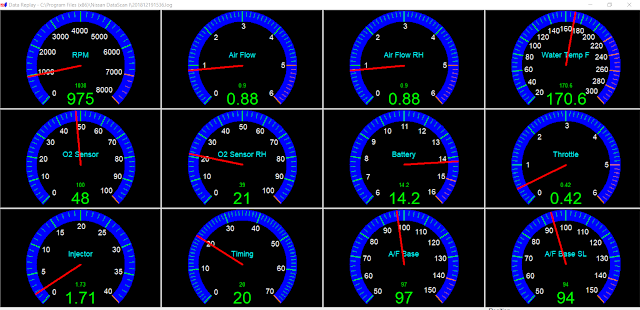 |
| Nissan Datascan for early Nissan ECU monitoring |
If you have a stock ECU, then I really like the ECUtalk as a nice tool to be able to quickly look at many engine parameters. They are $320-$335 AUD. Along with monitoring, they can adjust timing and fuel if you want to be able to troubleshoot, do some very basic global type tuning.
 |
| ECUtalk. Speed, RPM, voltage, Engine temp, 02, AFM, TPS |
 |
| The MDM-100 does similar stuff. Its helpful to help diagnose a vehicle with a stock based ECU |
2) Oil for Nissan Skyline GT-R
- Recommended: 7.5W-30 (Japan R32), 10W-30 (R34), 10W-30 synthetic for street cars, 10W-60 for performance driving. Oil Change/Filter change.
- Capacity: 4.5 liters (stock). Filling to the dipstick bump is generally acceptable.
- Brands: Pennzoil, Redline, Royal Purple, and Liqui Moly are popular choices.
- Resources: Check out "Bob is the Oil guy" for in-depth oil discussions.
- RB26 Oil Leaks: Where does the RB26dett leak from?

 |
| LiquiMoly 10w-60 |
Engine Lubrication and Cooling Fluid Capacities for Nissan Skyline
3) Oil Filter for RB26dett
OEM 15208-60U00 OEM R32 AY100-NS007

K & N HP-2008 (discontinued) MOBIL M1-208 (hard to get locally) WIX 51361 OEM(R34, smaller filter) 15208-9E000
(Discontinued, Replaced by the HP-1002)
4) Fuel - 91 AKI(RON+MON/2) in California. Higher some places . You don't want to run anything less than the highest octane pump gas available. Japanese 100 octane, is not 100 AKI. Its about 95 AKI.
| Item | RB20E/RB25DE | RB25DET | RB26DETT |
|---|---|---|---|
| H Level | 4.2 | 4.3 | 4.8 |
| L Level | 3.2 | 3.5 | 3.7 |
| Oil and Filter Change | ~ 4.4 | ~4.8 | ~4.9 |
| RB20/RB25DE/RB25DET | RB26DETT | |
|---|---|---|
| Capacity | ~9 | ~9.2 |
| RPM | Idling | 2000 | 6000 |
|---|---|---|---|
| RB20E | ~1.0, 14 | ~3.8,54 | ~4.8,68 |
| RB25DE | ~1.0, 14 | ~3.3,47 | ~5.3,75 |
| RB25DET | ~1.0, 14 | ~3.5,50 | ~5.6,85 |
| RB26DETT | ~1.5, 21 | ~3.0,43 | ~4.6,65 |
 |
| MotoRex R34 GT-R.in Bayside Blue |
3) Oil Filter for RB26dett
- 3/4-16 thread
- 4.280 inches height (108 mm)
- 3.120 OD (79 mm)
- Anti drainback valve
- Replaced by the K & N HP-1002
- 3/4-16 thread
- 3.75 inches height (95 mm)
- 3 inches OD (76mm)
- Anti drainback valve
- 3/4-16 thread
- 4 1/8 inches height (104 mm)
- 3 1/4 OD (82mm)
- Anti drainback valve
 |
| K&N HP2008 oil filter. 1 inch nut on the end, and provision for safety wire |
4) Fuel - 91 AKI(RON+MON/2) in California. Higher some places . You don't want to run anything less than the highest octane pump gas available. Japanese 100 octane, is not 100 AKI. Its about 95 AKI.
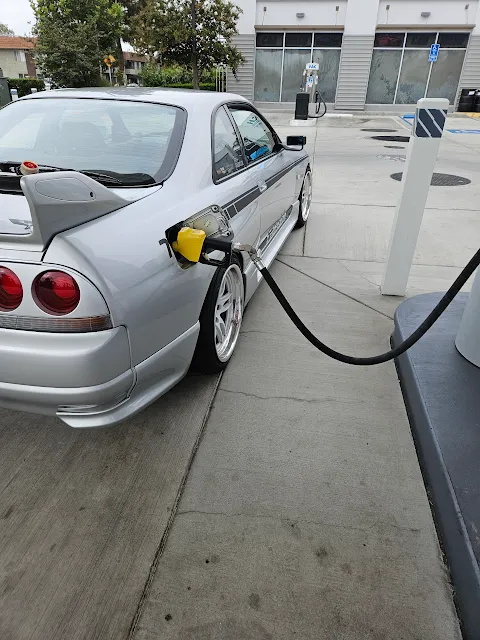 |
| Filling up the Dai R33 GT-R with E85. If its available and you aren't using it, you are doing it wrong on a turbo car. |
E85 has become popular the last few years for turbo cars. here are some issues in not having E85 in a flex fuel format, where you can run a tank of E10 (aka pump gas) through it every now and then. E85 is also not always E85 but can range from about E70 to E90. So far, E85 has been great. Cheap, works well, and we really didn't change much to support it. In 2023, if you have access to it, highly recommend E85. You do need to make changes to support E85 (ECU, Injectors, Flex fuel sensor), but its a great fuel that is cheap, and will do exactly what you want it to do in a fun car. Keep the tank full, and buy good E85.
What kind of gas should I put in my Nissan Skyline?
5) Air filter - If you are using the stock air box you can put a K& N part # 33-2031-2 OEM –16546 –V0100 , Fram CA4309. Fits R32,R33 ,R34. Part of making power is Air in /Air out. I like using the stock air box. Most aftermarket filters manage to suck in a bit of hot air. Plus if you have to deal with the police in certain states, its better to look stock, than look modified.
 |
| Filling up the #bluecar with E85. |
 |
| R33 GT-R with stock airbox, and air inlet. |
5) Air filter - If you are using the stock air box you can put a K& N part # 33-2031-2 OEM –16546 –V0100 , Fram CA4309. Fits R32,R33 ,R34. Part of making power is Air in /Air out. I like using the stock air box. Most aftermarket filters manage to suck in a bit of hot air. Plus if you have to deal with the police in certain states, its better to look stock, than look modified.
Intakes without airboxes testing.

6) Spark plugs - PFR6A-11 are the stock Nissan Skyline GTR plug made by NGK. PFR7A-11 are one heat range cooler, also from NGK. You may want to tighten the plug gap up if you are going to up the boost. Stock gaps on these plugs are 1.1mm (0.43 inch) which is pretty wide for a spark plug.

6) Spark plugs - PFR6A-11 are the stock Nissan Skyline GTR plug made by NGK. PFR7A-11 are one heat range cooler, also from NGK. You may want to tighten the plug gap up if you are going to up the boost. Stock gaps on these plugs are 1.1mm (0.43 inch) which is pretty wide for a spark plug.

NGK Iridium's work well(BCPR7EIX). With the NGK's we haven't had a problem.
 |
| Heat range 10 fine wire vs a heat range 7 RB26 iridium plug |
Check out this great video on diagnosing misfires. The issues with having the coils in the valley of the head, and covered, is they cook. I personally think that about 40% of peoples issues with misfires, are the coil harness cooking in the valley. 20% is probably spark leaking from the boot. 10% the plug. 10% the coil. 20% the ignitor, ecu, or CAS. It takes about 5000 less volts to arc a iridium plug vs a copper plug. So generally an iridium plug will help your ignition system last longer, fire easier.
7) Fuel filter - Same as a 1996 Infiniti J30 and other Nissans. Its a good idea to change it when you get the car. Its almost the same as a 300ZX filter, but the outlet has a 90 degree bend on the actual filter. G5237 1/4" ID , 5/16" OD inlet and outlet. Nissan Part Numbers 16400-72L00, 16400-72L05, 16400-72L15
 BCPR6EIX Street / OEM+ Buy |
 BCPR7EIX Mild boost 450–600hp Buy |
 R7436-9 Track-only / 700+hp Buy |
 |
| G5237 fuel filter that fits on all Nissan Skyline GT-R |
7) Fuel filter - Same as a 1996 Infiniti J30 and other Nissans. Its a good idea to change it when you get the car. Its almost the same as a 300ZX filter, but the outlet has a 90 degree bend on the actual filter. G5237 1/4" ID , 5/16" OD inlet and outlet. Nissan Part Numbers 16400-72L00, 16400-72L05, 16400-72L15
8) Transmission fluid - Don't try and fill it through the gear shifter for a Skyline GT-R. Get a good GL4 75-90. (We love Redline Shockproof Heavy in a hard run car). The R34 GT-R uses specific fluid Nissan part KLD40-00004 or 08885-01306 from Toyota, or we have used Redline High Temp ATF, and Royal Purple ATF.
 |
| The Skyline GT-R transmission must be filled from the side, not the gear shifter |
 |
| FS5R30A Nissan Skyline GT-R transmission and transfercase |
9) Front Differential - GL5 85-90

10) Rear Differential - LSD GL5 80-90

11) Transfer Case - Nissan Automatic Fluid Type D

12) ATTESA System - Nissan Automatic Fluid Type D
13) Fluid Fill Levels for R32/R33 Nissan Skyline GT-R
Engine Oil - 7.5 - 30 (10-30 for a street car, 15-50 on a track car) or a 10-60 is great all around. - 4.5 liters
Oil Filter - OEM 15208-60U00 , WIX 51361 ,OEM(R34, smaller filter) 15208-9E000
Cooling System - Green. Approximately 9 liters. Gycol or Water? Depends where you live.
Front Differential (F160) - GL5 85-90 1 liter - (1 quart)
Transmission fluid - Don't try and fill it though the gear shifter. Though the gear shifter is the transfer case . GL4 75-90 4.1 liters (4.3 quarts)
Transfer Case - Nissan Automatic Fluid Type D 1.8 liters (1.9 quarts)
Rear Differential(R200) - LSD GL5 80-90 1.5 liter(1.5 quarts)

10) Rear Differential - LSD GL5 80-90

11) Transfer Case - Nissan Automatic Fluid Type D

12) ATTESA System - Nissan Automatic Fluid Type D
13) Fluid Fill Levels for R32/R33 Nissan Skyline GT-R
Engine Oil - 7.5 - 30 (10-30 for a street car, 15-50 on a track car) or a 10-60 is great all around. - 4.5 liters
Oil Filter - OEM 15208-60U00 , WIX 51361 ,OEM(R34, smaller filter) 15208-9E000
Cooling System - Green. Approximately 9 liters. Gycol or Water? Depends where you live.
Front Differential (F160) - GL5 85-90 1 liter - (1 quart)
Transmission fluid - Don't try and fill it though the gear shifter. Though the gear shifter is the transfer case . GL4 75-90 4.1 liters (4.3 quarts)
Transfer Case - Nissan Automatic Fluid Type D 1.8 liters (1.9 quarts)
Rear Differential(R200) - LSD GL5 80-90 1.5 liter(1.5 quarts)
 |
| Fluid recommendations for R34, same as R32, or R33. Engine Oil and differential fluid viscosity is based on ambient temperatures. |
 |
| RB26 Fuel Injector Cleaning Results |
14) Fuel injectors - cleaning fuel injectors and results. These cars are old. It is generally unknown the last time the injectors were changed, or cleaned. We will assume never. If the car has sort of a popping sound from the exhaust at idle, or a slight roughness, it might be the time to clean your injectors. You can see that with cleaning, the above tested fuel injectors can safely supply from 316 hp to 411 hp of fuel, vs 249 hp to 324 hp prior to cleaning. If you let fuel injectors sit for too long, they can lock up, so we do recommend hitting them with 12 volts prior to installation. Or if you install them, and have a hard misfire, check each injector that it isn't stuck.
What needs to be upgraded , when ?
 |
| And to show you can't trust anything on the internet here is an identifier from NISMO. |

Fuel injectors - 444cc at 42 psi in 1989, or 1990, or 1991. It's not 1989 anymore. Lets just say that each cc of injector - on a 6 cylinder car is good for 1 hp... So with the stock injectors we can make 444 hp at the motor.... its just an approximation , but its pretty close. The stock injectors are "yellow" tops. They are also low impedance(2 ohm), so there is a resistor pack located on the right side of the engine compartment.
In the chart above you can see at 2.55 kg/cm2 (36 psi) of fuel pressure the injector flows about 440 cc. At 3.05 kg/cm2 (43 psi) of fuel pressure it flows about 485 cc. At 3.55 kg/cm2(50 psi) it flows 525 cc. Don't get too crazy with the fuel pressure. Your fuel pump relief valve might end the fun soon. More fuel system upgrade information here.
 |
| Stock R32 fuel pump rests in a small sump. Nismo pump top. Stock below. |
Fuel Pump
Turbos
 |
| RB26DETT turbos. Stock R32, R33, R34 GT-R. R33 N1, R34 N1, Nismo |
Records for stock turbos. Stock peak boost R32 Skyline GT-R is about 0.8 , R33 0.9, R34 1.0. Need to go to a full metal turbo. HKS GT series are good turbos. We have also run Apex'i AX series turbos. The 2530's or 2860-5's are the way to go with the small GT series for about 450-500 whp on pump gas on a 2.6 liter engine in a bolt on configuration.
 |
| Missing ceramic exhaust wheel |
Oil pump
 |
| Tomei Oil pump : The best wet sump RB26 oil pump |
Clutch
You can identify the clutch itself by the clutch cover. If it has open fingers, then its a push. If it has a ring, then its a pull. The stock Nissan clutches have gone low 12's, but in an R32. R33/R34 they give up pretty quickly. High 12's, slip them a few times, and they are done.At least a sturdy single plate. Nismo twin plate works well. HKS twin plate is fairly hard to drive , but you get used to it. It also makes a bit of noise. A triple plate is very difficult to drive in a street car. More information - http://www.gtrusablog.com/2015/11/push-vs-pull-clutch-nissan-skyline-gt-r.html
 |
| Push style, or early R32 GT-R clutch. |
 |
| Pull style, or late NISMO clutch for an R34 GT-R. |
MAF - The stock RB26 65mm MAF(Mass Air Flow) sensors are good for about 400 wheel horsepower. Above then they run out of range and max out their voltage. A popular replacement(in 2000) is the Nissan 300ZX meters. A 300ZX uses one MAF - we double up for the GT-R.They are physically larger. More recently the R35 blade style MAF have become popular. If the car seems to have a 2500 rpm limiter, its often the MAF having an issue. The solder connections from the connector to the board crack, and cause intermittent issues.
With most stand alone engine management, most cars go to a MAP(Manifold absolute pressure) sensor. The thing about MAP based tuning is that the density of air is dependent on temperature and pressure. Some ECU's swap over to MAP based load, but with the ITB's, it can be a difficult thing to tune for part throttle. TPS + MAP Tuning | Turbocharging with ITBs - Alpha N MAF troubleshooting and repair. OEM part number 22680-05U00
Strengths of Mass Air Flow
Oil Cooler - The stock cars run an oil/water heat exchanger. Its a good idea if you are going to go on a track, or do any high speed driving with the car to put an external oil cooler on the car. On a track, it only takes a few laps in cool outside temps to get the oil temps above the 110C range. As important as the cooler itself, is the ducting to and though the cooler core.
Camshafts - Stock the RB26DETT camshafts are 240/236 duration 8.58/8.28 mm of lift. If your aftermarket camshaft has more than 9.1 mm of lift, the head needs clearance around the lifter bucket due to the height of the camshaft lobe. Small cams will generally see at least 20 whp, and will generally also pickup response. Stock base circle is 32 mm. Many of the higher lift aftermarket camshafts have 30mm base circles. That means you have to make up that extra 2mm of difference in the shim height.
Strengths of Mass Air Flow
- Extremely accurate fueling and spark delivery across a diverse range of engine conditions (at least while in steady-states): the holy grail for engine management. A properly set-up MAF system can adapt to changes in weather and altitude with ease.
- Minor changes to engine equipment (i.e. headers, minor camshaft changes, intakes that do not significantly alter the placement of the MAF) do not require recalibration of the ECM.
 |
| OEM twin MAF with HKS foam filters |
 |
| Large Sebrab oil cooler being fitted to an R32 |
 |
| ARC grille oil cooler on the bluecar |
 |
| ARC oil cooler on a Super Taikyu R34 GT-R |
 |
| Airflow is important. Air has to be able to pass through a core. So pay as much attention to the exhaust side as intake |
 |
| Exhaust side cam cover removed. Do this if removing turbos in car. Thank me later. |
Camshafts - Stock the RB26DETT camshafts are 240/236 duration 8.58/8.28 mm of lift. If your aftermarket camshaft has more than 9.1 mm of lift, the head needs clearance around the lifter bucket due to the height of the camshaft lobe. Small cams will generally see at least 20 whp, and will generally also pickup response. Stock base circle is 32 mm. Many of the higher lift aftermarket camshafts have 30mm base circles. That means you have to make up that extra 2mm of difference in the shim height.
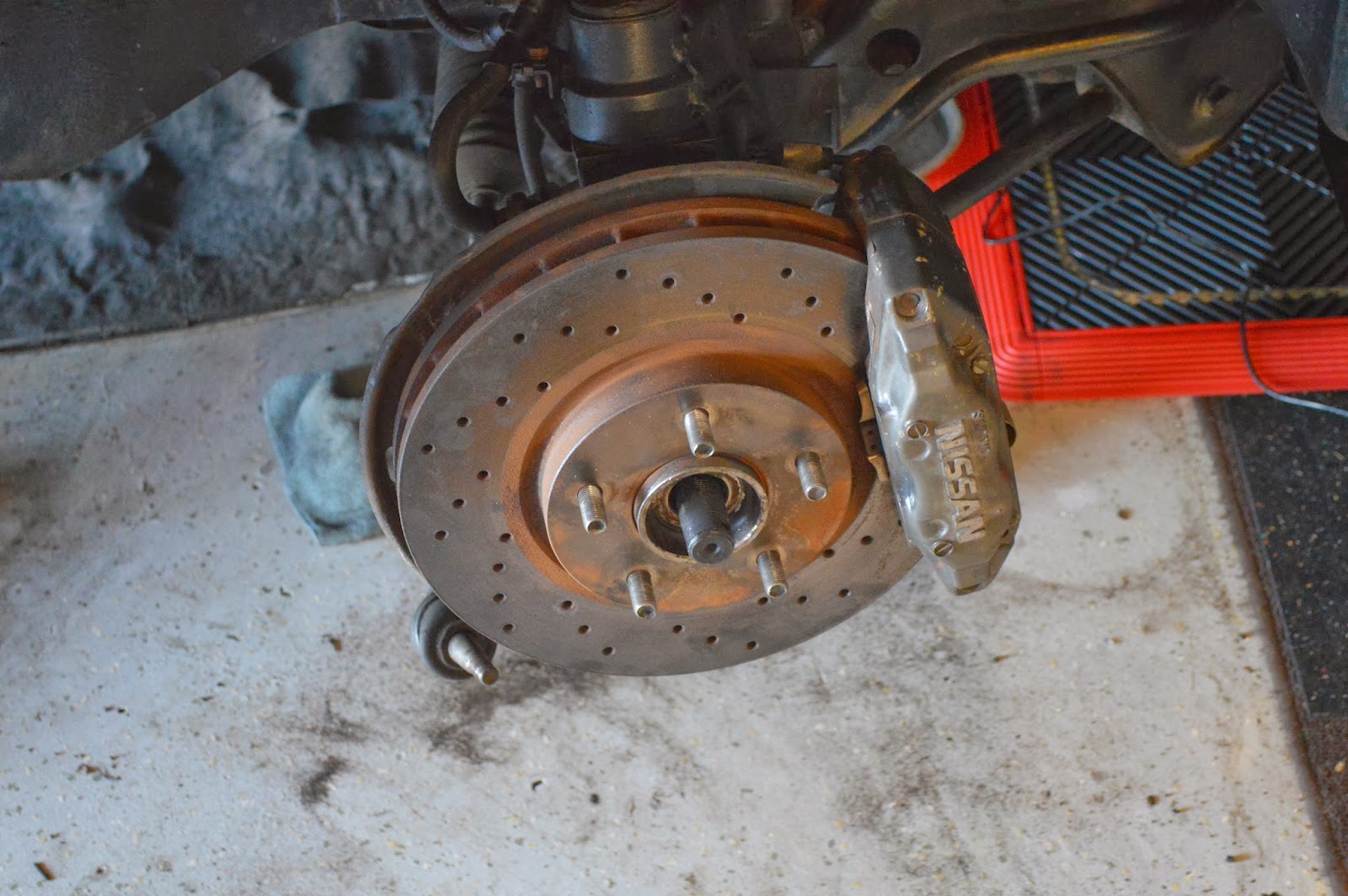 |
| This is a factory 296 x 32 mm cross drilled R32 GT-R brake rotor. |
Brakes -Stock R32 brakes are an upgrade for 300ZX's.Stock Vspec R32 brakes are Brembos. Stock R33 /R34 are Brembos. For most people these are adequate . Brake pads are up to whatever is the latest and greatest. Generally speaking if they work really well, they throw a lot of dust, and squeal like a stuck pig at low speeds. Brakes on 1990 Nissan Skyline GT-R NISMO #500.
 |
| R35 GT-R brakes on a CRS R34 GT-R. These are 380 mm x 32 |
What Breaks ?

Clutch
 |
| Pull style/ late R32/R33/R34 clutch. This is a Nismo |
 |
| Tilton carbon/carbon triple plate clutch. These clutches are all push style |
 |
| Late R32 bellhousing. This has bosses for push and pull clutch. It is currently a push clutch, or early. |
Transmission
Redline Shockproof Heavy Gear Oil. We used it in our 10.7 drag car with a stock transmission and it seems to really help with transmission durability. Some people say it hurts the brass in the trans, even Redline does not recommend it for a synchro box, but honestly if it is already making noises, or you are making a ton of power, it is your 100% best bet. Armchair mechanics, just repeat bad information over and over, without any real experience. 20 years of experience with these gearboxes now. If I actually thought it would do any harm, I would not tell you to use it.
 |
| Redline Shockproof Heavy gear oil STUCK to the gears in a FS5R30a transmission. Notice, synchros are not dead. |
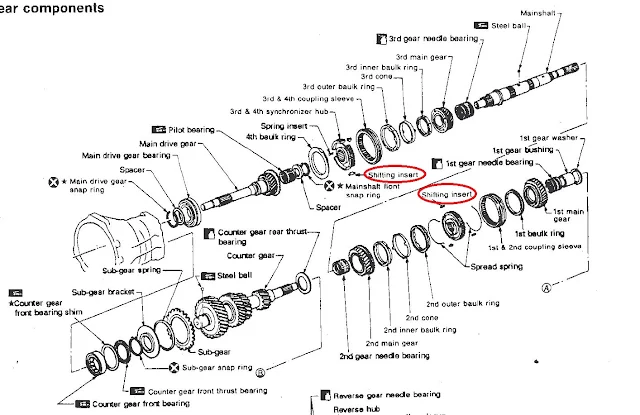 |
| Internal parts of a Nissan Skyline GT-R FS5R30A Transmission. |
The Getrag(V160) in an R34 requires its own special oil. The oil is available from Nissan part KLD40-00004 or Toyota dealerships and its $40 a liter. The Getrag does not like Shockproof Heavy, so don't use it in it. We ran Redline High Temp ATF in the R34 GT-R Racecar transmission with success.
OS Giken transmission internal upgrades for the R32-R33 seem to be good up to 700 hp. Speedtek and PPG have upgrades that fit in the stock gearboxes. If you want to go fast straight, there are some guys building a strong Nissan automatic box. Otherwise the New Zealanders, and Australians are going deep into the 7's on Powerglides, and 6's on the Turbo 400. The Turbo 400 is a 3 speed transmission, also a GM trans, that is a favorite of drag racers.
Sequentials are fun. Holinger was the original, followed by OS Giken OS88, PPG, Samonas, and more. They run in the 20k range, and are race car parts that need to be on a real service schedule. They are not OEM put it in run till the car is dead parts.
Turbos - The stock R32,R33 ,R34 turbos have ceramic exhaust wheels . Detonation has caused more than one of these to break off , thereby causing a normally aspirated GT-R. Don't detonate on the stock turbos. In Japan they say the limit is 1.1 bar.You can run more, just be prepared to change the turbos. Popular upgrades are going to a single turbo manifold. Our problem with singles are, the old manifolds, and turbochargers that are not divided exhaust inlet are a big less responsive than a proper twin turbo setup. Then the tubular style exhaust manifolds can crack, the flanges can warp. In 17 years, never had a OEM cast manifold crack or warp. In the same time, had a dozen different single manifolds crack, and warp.
Oil pump - Early R32's have an oil pump drive that is about half the width of the late R32/R33/R34 crankshaft. That combined with an 8000 rpm factory redline leads to the occasional mis shift over rev and the oil pump gears break.
 |
| Early and late R32/R33 transmissions broken 3rd gear |
Turbos
 |
| The wheel on the left is metal, the one on the right is ceramic. Yes, we have broken both |
Oil pump


The N1 oil pump is really not an upgrade for most. We had a lot of N1 oil pump failures. These pumps were direct from Nissan, not knock off's as some have speculated. Cavitation at the inlet side of the pump, align honing the block and not making sure the pump is square on the end of the crank. and just a poor design contribute to failures.
Many aftermarket companies make upgraded pumps. The motor has to come out, they cost $1000 and up. Crank collars, spline drives, external wet pumps, and dry sumps are all popular oil pumps in 2025.
 |
| Wide RB26 oil pump drive |

#6 cylinder - #6 cylinder is the lean cylinder. Every motor has a lean cylinder. Its also at the back of the engine, last to get coolant flow. The stock intake collector(not really a manifold as its on the front side of the throttle bodies) design forces air to stack up at #6. The Nismo inlet plenum was designed to balance flow though the motor. This is not really a basic, rather something just good to know. Just know that if you ever run the car lean, you will probably hurt #6 first. Also if you are checking compression or leak down, try out #6 first. The Nismo collector actually made some more power. About 10 kw(13 hp) increase up top, on a 565 kw(757 hp) engine. Motive Video below
 |
| Nismo plenum, stock airbox , 600+whp |
Vacuum/Boost Diagram for the RB26dett
 |
| RB26 vacuum boost diagram corrected in 2019 |
Axles, driveshaft, propshaft, half shafts, Constant velocity(CV) shafts
 |
| Torn right outer boot, R32 GT-R. |
Axles, driveshaft, propshaft, half shafts, Constant velocity(CV) shafts often all refer to the same parts, but different regions of the world use different terms. To me, we call the shaft that extends from the front or rear differential to each wheel an axle. On the front because you not only have up and down, in and out, but back and forth movement, they have a tendency to wear overtime and split. Once the boot splits, the grease is tossed out, and you will eventually get metal on metal operation and failure.
Part numbers and cross compatibility
Nissan Skyline GT-R Differential : Front, Rear, and Middle
Axle removal for a Nissan Skyline GT-R. http://www.gtrusablog.com/2013/03/cleaning-and-axeling-in-long-beach.html
Why you shouldn't use a Japanese market tuned ECU
Japanese market premium fuel is rated at 100 octane(RON) .They use a different method of determining octane in Japan. Here in the US -Southern California our premium fuel is 91 octane (RON+MON/2) or AKI . Of course you can buy 104 unleaded from VP. You can also buy 100 octane unleaded out of the pump at some 76 stations. But for all practical purposes 91 octane is as high as you will get here in Southern California. Some places in the US you can get up to 94 out of the pump at "normal" gas stations. If you don't run enough octane for the tune on the ECU, you will often get knock, or detonation. This detonation kills engines, and breaks turbochargers.
Axle removal for a Nissan Skyline GT-R. http://www.gtrusablog.com/2013/03/cleaning-and-axeling-in-long-beach.html
 |
| All the octane choices, including diesel. Did you know there is a diesel version of the RB? The RD28. |
Why you shouldn't use a Japanese market tuned ECU
Japanese market premium fuel is rated at 100 octane(RON) .They use a different method of determining octane in Japan. Here in the US -Southern California our premium fuel is 91 octane (RON+MON/2) or AKI . Of course you can buy 104 unleaded from VP. You can also buy 100 octane unleaded out of the pump at some 76 stations. But for all practical purposes 91 octane is as high as you will get here in Southern California. Some places in the US you can get up to 94 out of the pump at "normal" gas stations. If you don't run enough octane for the tune on the ECU, you will often get knock, or detonation. This detonation kills engines, and breaks turbochargers.
What fuel should I put in my Nissan Skyline?
Air Conditioning
Some of us are old, and like our air conditioning. Others live in an area with lots of heat and humidity. 25+ year old air conditioning systems normally use R12, which is the same as unicorn blood, in ease to obtain in North America. A/C systems are fairly complex, as they have a lot of parts. They are mechanical, electronic, and they have gases under high pressure. They really aren't for the novice to automotive repair. Generally we would recommend taking the car to an A/C repair shop to discharge, or recharge the system. While the Nissan Skyline may never have been sold in the US, the parts of the system are very similar to other models sold in the US. More information on the
Air Conditioning
 |
| Brand new R32 GT-R R12 A/C compressor |
 |
| R12 fill. 0.75-0.85kg for R32 |
 |
| R33 GT-R R134a fill, and recommended oil for AC |
 |
| R34 GT-R R134a fill, and recommended oil for AC |
 |
| #bluecar |
- Index- please start here to help find something
- R32 GT-R Buyers Guide - Are you looking to buy an R32? Check here.
- Advanced Notes - after you are finished with the basics, check out some of the advanced notes.
- Suspension and Alignment Settings - R32,R33,R34.
- Nissan Skyline GT-R Transmissions and Upgrades
- Is it legal to drive a RHD car in the USA?
- Nissan Skylines in the USA for sale at importavehicle.com
- Does Your HICAS Light Turn On After Five Minutes of Driving?
- R33 GT-R Buyers Guide
- R34 GT-R Buyers Guide
- How can I finance or make payments on a JDM car?
- How do I build a 500 hp Nissan Skyline?
Fire extinguisher and bracket


 |
| R32 GT-R imported by importavehicle at Laguna Seca. |
 |
| Legal JDM vehicles to the USA. Toprank Importers. |


46 comments:
Hi Tyndago!
I'm having cold start problems, and bit of rough idling. I need to step on the gas pedal to make the GT-R start. And upon checking some of my plugs are wet w/ gasoline. :( No error codes detected, split fire coils, BCPR7ES plugs...
Maybe a leaking injector. Maybe a MAF issue. Maybe a leak in the intake path. Splitfire coils are crap. My cars always ran better with stock coils, and a new coil harness.
Ok. Funny thing is it happens a lot on cold starts only. When the car is warm it's no problem. I could scratch the MAF out since I tried another set before. Hmmm...intake path leak, and leaky injectors. What's the standard vacuum of the RB26 at idle, 0.5 (a/c engaged) to 0.8 (a/c off)? And what are the signs of a leaky injector? The car idles quite ok, but not as fine as before.
Split fires are crap? :) Maybe that is why they are now almost at the same price w/ the oem ones
Leaking overnight. Other than pulling them out and testing not a lot.
Although injector seals, or other seals leaky that seal up when the car warms up is pretty common. Often the injector seals.
Thanks for the tips! Another thing discovered is the wet plugs seems to jump from num. 3 and num. 4 cylinder.
3-4 is probably that throttle gasket. There are 2 gaskets there, one on each side of the throttle body.
Nice topic. By the way leaky injectors will be obvious since there will be traces of gasoline on the top injector (exposed side), and will be fixed via new o rings... Or... is there a kind of injector leak that can't be fixed by them o-rings? Like the leak is coming from the injector body/tip area itself?
Hello Tyndago!
Do you have any info on what is the function of the clutch pedal switch? Was adjusting clutch engagement on pedal when I saw it. Tried checking it on FSM, and the function of it wasn't described at all.
Does all GT-Rs have it?
Thanks in advance!!
All the GT-R's have them. Most cars in the US won't start without the clutch in.
The JDM GT-R's will start with the clutch out. I am sitting here thinking that the late R34's might have needed the clutch in to start, but I can't remember exactly.
I can't think of another purpose other than starter lockout.
Hey!
Was googling GT-R stuff and stumbled to your site most of the time. ;) Anyways, how do you go about bleeding the GT-R BNR32 and 34 brakes, Brembo ones. I know the basics like the furthest one first up to the master cylinder. But since these Brembos have 2 nipples, w/c do you bleed first? And is there a need to bleed the ABS also if you replace the master cylinder? W/c nipple first on the BNR32 ABS?
Lastly, you were most helpful on GT-R owners around the world! Thanks You!
On the Brembos with two bleeders, do the outside first, then inside, on each caliper. Like the furthest to closest idea.You don't need to do each out then each inner. I would start the car, and bleed the ABS unit. You don't want any trapped air. Just makes everything feel bad.
Regarding the brakes, so it doesn't really matter if I don't follow the outer then inner nipple bleeding? I just saw on different forums stating the opposite, inner then outer and actually saw an old post from you also on GTROC back in '06 (http://www.gtr.co.uk/forum/60045-bleeding-r33-calipers.html). ;) And do you really need to start the car during the bleed process? Just saw the FSM, and it even says to remove the battery terminal before bleeding.
Thank you again!
I was probably wrong there. Although its kind of 6 one way half dozen the other. Its not as critical the order, as trying to get all the air out around each piston. Sometimes you have to drive the car, or hit the calipers with a rubber hammer to free up air. Outer then inner, just like doing the furthest wheel from the master first. The outer is further away from the master, inner is closer to the master.
I would leave the car off the first time, then after the first round, when you have a decent pedal start the car, and run around the car once. On the R35 the procedure actually says to "Run the vehicle until the surface temperature of caliper reaches 70 to 80°C (158 to 176°F), and then perform
the stops 1 to 8 with the caliper heated".
If you replace the master running the car can trigger the ABS and move some of the trapped air around. The whole thing we are trying to do is get rid of all the trapped air. Any air will give you a bad pedal.
Sean,
Do you have an article on regular maintenance? My R34 is approaching 100,000km on the odometer. I'm prepared to throw some money at the car to give it an overhaul. What should my focus be for a GT-R with this mileage?
Thanks!
Hello Sean!
I have a 92 GT-R and I bought it a Trust oil pan drain bolt (those with magnet). to my surprise it won't fit, it is much smaller! Thinking it was just a wrong part sent I tried another plug for RB26 GT-R32 but again it is smaller! :/
Now I'm wondering Sean, does a Zenki one have different oil drain plug? Or mine is a different pan or was over sized already? :(
Is the Trust drain bolt for their pan? They have a specific add on oil pan piece. As far as I know, all the pans are the same. 14 mm bolt heads.
The trust drain bolts are made all Japanese brands and it says compatible with the GT-R 32.
I don't know if my pan is aftermarket since it looks oem, I was hoping the built in nut on the pan was not "oversized" by the previous owner because of broken threads. :/
Going to check it again on my next oil change if the thread size is up 1 compared oem so if it does I can use Helicoil to get back to the original size.
Hi there sean! Very nice blog here! 8) Was searching this on your blog but came up empty. This is for all other GT-R owners out there. Anyways question is--
True or False that the curved clutch fans of the BCNR33 and BNR34 is better than the straight ones the BNR32 has?
I'm going to replace my clutch fan assembly, and I can use the GTR33 fan or retain my old GTR32 fan. Tried fitting the 33 ones (I have a Blitz thick rad BTW) and since the blade is curvy it has a very small clearance with my crank pulley maybe about 2 - 3mm only. Is this safe? On oem radiators this won't be an issue at all since they're much smaller. I think the plastic fan might flex at high speed so I don't like the idea of maybe it'll hit the pulley. :)
I know this situation might crossed you as well. So what do you say about curve vs. straight fans. Is it worth the small clearance for guys having aftermarket radiators?
All the best!
Honestly, I haven't put much thought into the fan. The mechanical clutch works better than most of the old electric fans. Generally the later cars parts are improved over the earlier cars parts. If its only 2-3 mm I would be a bit afraid of it hitting. I have seen a cut/ground down fan, but you would have to be a bit careful with balance. Remember the fan is only really there for low speed, once you are moving, you should have enough natural air flowing though the radiator to cool the car.
Hello sir Tyndago,
Any guides on how to properly replace engine and transmission mounts on? Do we need engine hoist or just jack?
A friend convinced me to DIY it but a bit unsure on how to safely do it for us and the car.
Thanks!
I have never tried to replace them in the car. The trans should be pretty easy. Just unbolt and jack up the end of the trans. The engine mounts, if you drop the subframe a little and support the engine from the top it would be easier. However you have a lot of parts in the way of the engine mounts. Not impossible, but you need some kind of lift and support, and some spare time. Something I would save for the next time the engine is out.
With being said... is Engine Torque Damper a good useful upgrade for a street GT-R that also sees track days sometimes?
Cheers!
Never ran one on the race car.
Good day Sean!
Tried doing a compression test on my GT-R today, And I got an ave. of 135-140 across all the cylinders. Done this on a warm engine, not too hot though. Is this value a little low for RB26 standards?? I've been reading like 150 - 170 is the normal values. :/ Good thing is they have the same numbers all through out though.
The engine has been rebuild last year, new piston set, 1.2mm gasket. Little nervous here.
There are 100 ways to do a compression check wrong. I have seen gauges that are 30-40 psi off. If you do compression check, just look for the average across all the holes. If its 100, or its 120, you want to make sure they are all around the same. If you really want to check the health of the engine, get a leak down tester.
Copy!! So basically on these compression testers the MOST IMPORTANT thing to consider is it reading out values that are almost if not the same across all 6!
Thanks! I can breath easy now since mine is giving out similar numbers 135-140 on all six. Was nervous since I just had a usually pricey RB26 rebuild. Maybe I'll try the leak down test next.
Its close values across all 6 that are important, exactly. A leak down test, you use air from an air compressor to fill the combustion chamber when its at TDC. You can then see a percentage of loss. 1%,5%, 10%. You can also tell where you might have an issue. If you hear air out of the oil fill, probably a ring/piston. Hear it out the intake, intake not sealing right. Out the exhaust, exhaust not sealing right.
hello,
yesterday I did a compression test in my 1990 gtr, with 145,00 km, so the result was 130psi in all 6 cylinders, so its bad?
130 psi means nothing. Its just a number. What you are looking for is a balance. If you actually want to test the condition of your engine, do a leak down test. I think compression tests are a waste of time.
Hello guys in real need of advice, I have oil leaking into my turbos I own a 1990 skyline gtr r32 I had my turbos rebilt last summer and the problem is still happening. Is there anything else I could have missed.
Does anyone have the part number for the GTR rear diff or know of any cross compatible ones? Is the z32tt the same??
You should mention in the clutch section. The early R32s had a Push style clutch, and later 32's,33 and 34s had a Pull Style clutch.
Thanks. I mention it in a round about way with captions, but I will put it in the text. I have an entire page of clutch and transmission information.
Isn't it Nissan recommends Nissan E-TS oil for the ATTESA? Or we can also use Nissan Matic D on it?
Hi I just found your site. I have a 1989 R32 and once the clutch is released all the way and the car has stopped (like at a stop sign) I can't push the clutch back in to switch into gear to start driving again. The car has to be turned off and back on. It has a Tomi shift kit. I just bought it, so I don't know if it's always been like this or not. Any advice? Thank you. Jen
I have had a similar issue, when the clutch needed bleeding. If you can get the car in the air, have someone watch the slave cylinder movement. Also, how does the pedal feel?
Quick question. On my r32 there is a button just to the right of the steering wheel that has a picture of a small fan an a big fan. What exactly does that button do?
Its some kind of fan controller. Normally it turns on the AC fan, regardless if the AC is on or off. Have to flip it and see what happens. Some aren't connected, just long lost ghost switches.
It controls the fan at the rear windshield
Quick question Sean I just drained my gearbox oil on my r32 GTR skyline and only got about 2 point something litres where I'm reading it's suppose to take 4? I then added 3 quartz of redline heavy at the end of the third one it started driping out the filler hole. Is it not suppose to take 4?
Transmission fluid - Don't try and fill it though the gear shifter. Though the gear shifter is the transfer case . GL4 75-90 4.1 liters (4.3 quarts)
Sean,
I live in Yokohama. I have a clean '99 White R34 V-Spec and I have pondered a trade for a real or replica clean Hako or Ken Mary. I've even considered a LHD R35, is it a pipe dream or not?
What type of coolant should be used? (RB20DET)
So I Have an Issue.. my oil Drain plug.. as I screw the bolt back into the drain plug hole.. it still has a little loosen movement... what do I do...
It has probably stripped the thread. You need to Helicoil it.
Thanks for the information. I really like the way you express complex topics in lucid way. It really helps me understand it much better way. nissan skyline R31, 32, R33, R34 R35 engine
Post a Comment